
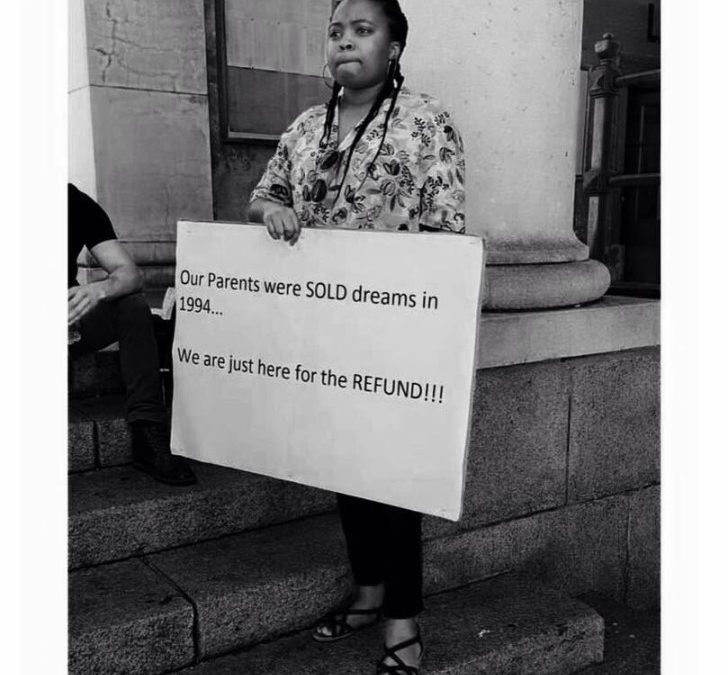
It is not about student fees. It is not even about universities being unreasonable. It is about public affairs. And it seems most of us, especially government and the universities missed it.
publicaffairsjobshq.com defines public affairs as “a profession that deals with the deliberate communication of relevant information between interested parties and their political representatives”.
What has now come to be known as the #FeesMustFall campaign is for me an excellent example of public affairs much like the Arab Spring a few years ago, June 16 Uprising, Sharpeville in 1960 and yes the farm grabs in Zimbabwe at the turn of the century, among others.
Looked at exclusively, these events miss the bigger picture, something deeper brewing in society. And to know it, as publicaffairsjobshq.com advises, we need to deal with the deliberate communication of relevant information between interested parties and their political representatives.
Frankly, I believe both the government and the collective of our universities missed it completely. Both entities, reduced this to a minor irritation by a few students – possibly (mis)led by political opportunists – to fight against student fees.
When this matter first came up at Wits University, the university leadership all but shrugged their collective shoulders and pretty much told the students to “deal with it”.
This was not different when the students at the University of Cape Town led the RhodesMustFall campaign earlier in the year, demanding the removal of the statue of Cecil John Rhodes from the premises of the university. UCT leadership was dismissive and almost insulting to the intellect of the students.
At Stellenbosch, the leadership went so far as to apply for a court interdict barring students from protesting against what they legitimately felt was a matter of life and death.
When government weighed in, it was late. Higher Education and Training Minister Blade Nzimande’s convinced the universities to agree to and offer a lifeline to the students: the fee increases would not exceed 6%.
Alas, this was too late. Yes when the students first protested at Wits, they demanded fee increases that are not above inflation. But by the time the call had grown to a national campaign, students were now rejecting any kind of fee increases.
Therefore the “solution” suggested by Minister Nzimande and the university bosses was now, shall we say, as much as a band aid on a festered wound whose pus was not only thick and visible, but had also caused a big stink across the country.
At the time of writing this piece, no less than 14 universities had joined the protest and the call #FeesMustFall was now trending internationally. In short, everybody had misread the current affairs.
Because let us face it, the issue of exorbitant fees is not new. It was not born two weeks ago when Wits students protested. It has been in the news every year almost for a decade now.
But everyone buried their collective head in the sand. Everyone believed this too shall pass. Didn’t Muammar Gaddafi also believe the angry youth will also get tired? Didn’t white Zimbabwe think that the angry masses will one day keep quiet and move on?
Before you accuse me of supporting anarchy, let me state that I always advocate for things to be done peacefully and where possible within the confines of the law. The bad news is that when peaceful means achieve little, at some point, something will give. It always does.
The cost of education has spiraled out of control. And if no one knows this, then none so blind than those who refuse to see. Ordinarily, it should and would have been those who pay the fees – the parents – to raise a stink.
But as it has always happened in history, the older generation takes long to be impatient, if ever. But once the cudgels are taken by young people, you can be sure that the sluice gates of anger cannot be easily shut, and sometimes, not even by arms or force. Or both.
The university leadership misread the growing unhappiness about general transformation on campuses. They looked inside and always thought they could out-reason the students.
RhodesMustFall and all other campaigns linked to it at the time, was an opportune wake-up call for the universities to do a major introspection to say: “What is wrong with us, and what can we do to arrest future crisis.” They missed the opportunity.
Government, like it has done with many other issues of public discontent, also did not read the public affairs signs all over the campaigns rolling out in universities. This was a great opportunity for a major policy review and doing things differently.
I commend Minister Nzimande for his 6% proposal. At least he put something on the table. But #FeesMustFall and other campaigns are no longer about short-term responses and reactions.
When you fail to understand public affairs, the next obvious thing coming your way is reputational failure. Right now, the government’s and university leadership reputations are flat on their tummies.
The students have the upper hand and the moral high ground. In spite of the sometimes violent nature of the protests, there is now a groundswell of people who are saying “good on you”.
The problem of education is historical and structural. Historical in the sense that right from the days of apartheid, it was always designed to exclude the poor. Structural in that universities, in spite of being “public institutions”, are autonomous and can take such detrimental decisions as above-inflation fee increases unilaterally.
If all concerned read the public affairs correctly, the course of history and the old structures needed to change, a while ago. Or else this is just a tipping point.
Recent Comments